
Preserving Your Options: The Science-Backed Guide to Egg Freezing (Timeline, Age, and Realistic Success Rates)
Considering freezing your eggs? Discover how the egg freezing process works step-by-step, the best age to freeze, how many eggs you need, and realistic success rates.
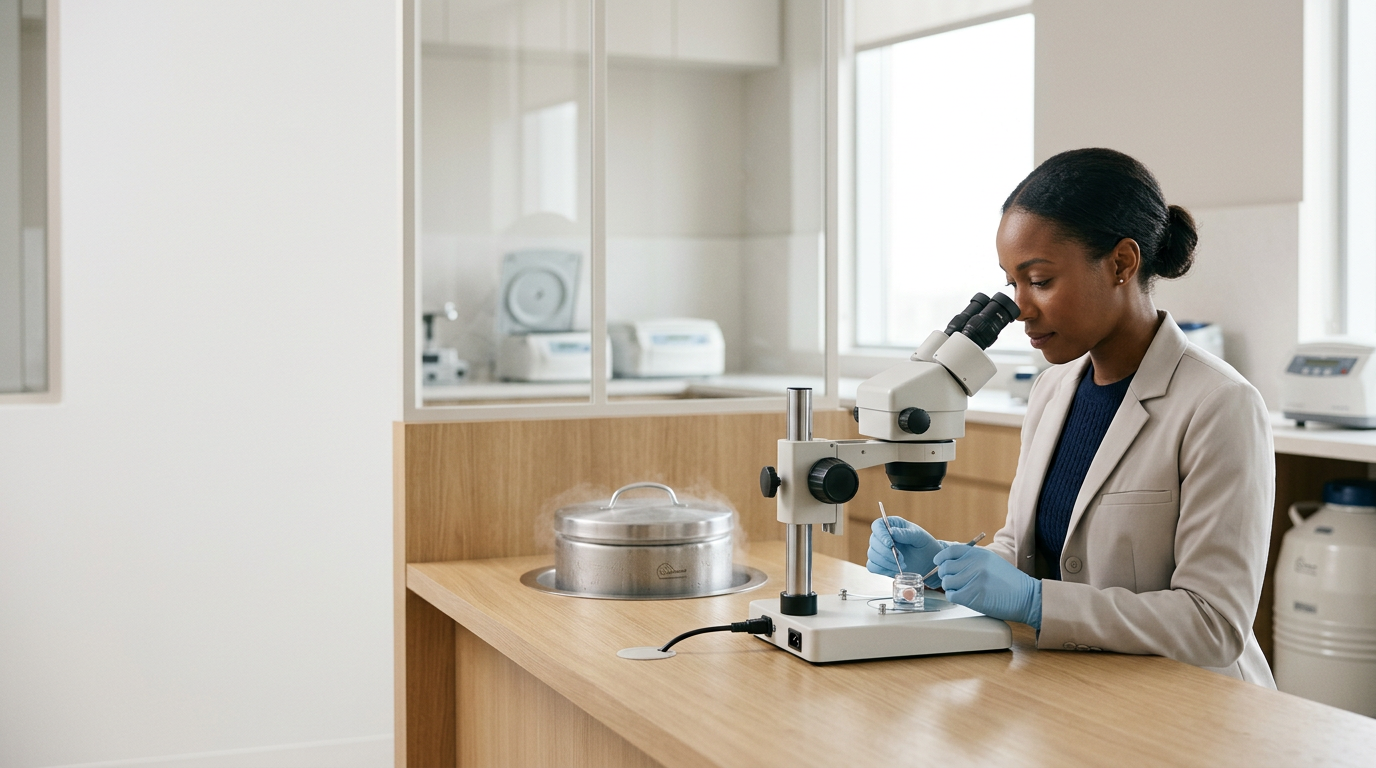
For decades, fertility conversations were dominated by a ticking clock. Women were told that if they were not ready to start a family in their twenties or early thirties—whether due to career goals, personal timing, medical treatments, or simply not having met the right partner—their reproductive window was slipping away.
Today, advanced reproductive technology has shifted that narrative entirely. Egg freezing (oocyte cryopreservation) has transformed family planning from a race against biological time into a proactive, empowering medical choice.
Freezing your eggs does not guarantee a future baby, but it acts as a biological insurance policy. It allows you to pause the aging process of a specific cohort of eggs, preserving their cellular youth and genetic integrity for whenever you are ready.
If you are considering egg freezing, understanding the medical science behind flash-freezing, the realistic numbers required for success, and what happens during the 14-day cycle will help you make an informed decision without fear.
The Technology: How Vitrification Changed Everything
If you researched egg freezing a decade ago, you might have read about low success rates. In the early days of reproductive medicine, eggs were frozen using a technique called "slow freezing."
Because an unfertilized egg is the largest single cell in the human body and consists mostly of water, slow freezing often caused microscopic ice crystals to form inside the cell. When thawed years later, these sharp ice crystals frequently sheared the delicate internal machinery, leading to poor survival rates.
In the mid-2000s, reproductive embryology adopted vitrification—an ultra-rapid "flash-freezing" technology:
Sub-Zero in Seconds: Eggs are treated with specialized cryoprotectant fluids and instantly submerged in liquid nitrogen at -196°C (-320°F).
Glass-Like Solidification: The cellular fluid transitions into an amorphous, glass-like state without forming a single ice crystal.
Exceptional Thaw Rates: With vitrification, 90% to 95% of mature frozen eggs successfully survive the thawing process years later, performing with the same fertilization and pregnancy potential as fresh eggs of that exact age.
The Age Factor: When is the Best Time to Freeze?
In reproductive medicine, the best time to freeze your eggs is a balance between cellular quality and practical life utility:
1. The Biological Sweet Spot: Ages 30 to 34
Why it’s optimal: Women in their early thirties typically have an abundant ovarian reserve (high egg yields per cycle) alongside high egg quality (roughly 70% to 80% of eggs are chromosomally normal).
The outcome: You can often collect the target number of mature eggs in a single retrieval cycle.
2. The High-Value Window: Ages 35 to 37
Why it’s valuable: Ovarian reserve begins a more pronounced natural decline around age 35, making this the age group that statistically receives the highest clinical benefit and utility from their frozen eggs later in life.
The outcome: You may need 1 to 2 stimulation cycles to reach your target egg count, but preserving eggs at 35 or 36 offers a significant advantage over waiting until your late thirties or early forties.
3. Ages 38 and Above: Proactive Banking
Why it requires strategy: While you can certainly freeze eggs at 38, 39, or 40, a higher percentage of remaining eggs will naturally carry chromosomal abnormalities (aneuploidy).
The outcome: It generally requires more retrieved eggs to find the genetically balanced ones. At this stage, many women explore "batching" cycles or consider creating and genetically screening embryos (PGT-A) if a partner or donor sperm is available.
The Mathematics: How Many Eggs Should You Freeze?
One of the most critical discussions to have with your reproductive endocrinologist is: What is my target number of mature eggs?
Not every frozen egg will become a baby. To calculate your target, clinicians look at the oocyte survival and fertilization funnel:
Not every frozen egg survives the thaw (~90% survival).
Not every thawed egg fertilizes with sperm (~70% to 80% fertilization).
Not every fertilized egg reaches the day-5 blastocyst stage (~40% to 50% blastocyst conversion).
Not every blastocyst is chromosomally normal (euploid) or successfully implants.
General Clinical Egg Targets:
Under Age 35: 12 to 15 mature eggs provide an estimated 80% to 85% probability of at least one future live birth.
Ages 35 to 37: 15 to 20 mature eggs provide an estimated 75% to 80% probability of at least one future live birth.
Ages 38 to 40: 20 to 25+ mature eggs are typically recommended to reach equivalent cumulative birth probabilities.
The 14-Day Cycle: Step-by-Step
From the day you start daily injections to the day of your egg retrieval, the active treatment cycle takes approximately two weeks:
Baseline Scan & Hormone Check:
Cycle Days 1 to 3.
On the second or third day of your period, you visit the clinic for a baseline transvaginal ultrasound to count your resting follicles (Antral Follicle Count) and confirm baseline estrogen levels.Daily Injections & Regular Monitoring:
Cycle Days 3 to 12.
You administer small, daily subcutaneous injections of follicle-stimulating hormones (FSH and LH) to encourage your monthly group of resting follicles to mature together. Every 2 to 3 days, you return for quick morning monitoring visits (bloodwork and ultrasounds).The Final Trigger Shot:
36 Hours Before Retrieval.
When ultrasound measurements show that the majority of your follicles have reached 18–22mm, you administer a precisely timed trigger medication. This triggers final chromosomal maturation and loosens the eggs inside the follicle walls.The Egg Retrieval Procedure:
Day 14.
Under light, comfortable IV sedation, a doctor uses gentle ultrasound guidance and a micro-needle to aspirate follicular fluid and collect mature eggs. The procedure takes 15 to 20 minutes; you wake up comfortably in recovery and return home the same day.Vitrification & Storage:
Post-Retrieval.
Within hours, an embryologist strips away surrounding cumulus cells to identify mature eggs (MII oocytes) and instantly flash-freezes them using liquid nitrogen vitrification for long-term secure cryo-storage.
90-Day Pre-Freezing Optimization
While your doctor controls your stimulation medication protocol, you control the follicular microenvironment in the three months leading up to your cycle.
Because resting follicles spend approximately 90 days in their rapid, energy-intensive growth phase before retrieval:
Fuel Mitochondrial ATP: Start taking Coenzyme Q10 (Ubiquinol, 400–600 mg daily) 90 days prior to your cycle to fuel cellular energy for proper chromosome division.
Optimize Vitamin D: Ensure your 25(OH)D levels are in optimal range (40–60 ng/mL), which supports healthy AMH expression and follicular response.
Eliminate Endocrine Disruptors: Minimize exposure to bisphenols (BPA/BPS in canned foods and plastics) and phthalates (synthetic fragrances), which can accumulate in follicular fluid.
Taking Control of Your Future
Choosing to freeze your eggs is an investment in your autonomy, career, and personal peace of mind. It allows you to live your present life fully, knowing that your younger biological options are safely preserved.
If you are curious about your ovarian reserve, want to check your baseline AMH and follicle counts, or are ready to design an individualized egg freezing protocol, schedule a consultation with our fertility specialists today.
FAQs
-
Frozen eggs can remain safely stored in liquid nitrogen indefinitely. Because vitrification suspends all metabolic and biological cellular activity at -196°C, there is zero biological aging or degradation over time. Babies have been born from healthy eggs and embryos that were frozen for more than 10 to 15 years with identical health and developmental outcomes to fresh cycles.
-
No. Every month, your ovaries naturally recruit a small cohort of resting follicles. In a natural cycle, your body produces only enough FSH to mature a single egg, while the rest of that monthly group naturally dissolves and is permanently lost (a process called atresia). Egg freezing medications simply rescue and mature the entire group that was already scheduled to be discarded that month. It has zero impact on your future natural ovarian reserve or your menopause timeline.
-
The active cycle—from your very first stimulation injection to the day of your egg retrieval—takes only about 10 to 14 days. Prior to starting, you will typically complete baseline fertility bloodwork, an ultrasound, and a consultation with your doctor, which usually takes 2 to 4 weeks to coordinate around your natural period.
-
Most patients require very little time away from work. During the 10 to 12 days of stimulation injections, monitoring appointments take place early in the morning and last about 15 to 30 minutes, allowing you to head straight to work afterward. You will only need to take the day of the retrieval procedure off to rest and recover from light anesthesia. Most women return to normal desk work the very next day.
-
Recovery is generally quick and straightforward. Immediately after waking up, you may experience mild period-like pelvic cramping, bloating, and light spotting, which typically resolve within 24 to 48 hours. Staying well-hydrated with electrolyte-rich beverages and using a heating pad provides rapid comfort. Your natural menstrual period will typically arrive 7 to 12 days post-retrieval, after which any remaining ovarian bloating completely subsides.
-
Embryos (fertilized eggs) are hardier than unfertilized eggs and can be genetically tested for chromosomal balance (PGT-A) prior to freezing, providing a clearer prediction of future live birth rates. However, freezing embryos legally binds you to the sperm source (a partner or donor). Freezing unfertilized eggs offers complete personal reproductive autonomy, allowing you to choose your future partner or family path on your own timeline.
References
Cobo, A., et al. (2020). Elective oocyte cryopreservation: Comprehensive outcomes of 6,423 cycles in a single center. Human Reproduction, 35(12), 2736-2746.
Goldman, R. H., et al. (2017). Predicting the likelihood of live birth for elective oocyte cryopreservation: a counseling tool for physicians and patients. Human Reproduction, 32(4), 853-859.
Practice Committees of the American Society for Reproductive Medicine and the Society for Assisted Reproductive Technology. (2021). Evidence-based outcomes of elective oocyte cryopreservation: A committee opinion. Fertility and Sterility, 116(4), 1012-1020.